The Odyssey
Updated: Oct 9
Chronos, Synchronos, and Kairos walk into a bar.
The bartender points to the clock on the wall, which shows 4:55 pm, and says, "Sorry, we don't open until 5."

Chronos says, "Your clock is slow - it is now precisely 5:01 pm."
Synchronos then goes to the clock on the wall and changes it to 5:01 pm.
The bartender protests, "Well, you may be right on the time, but that doesn't mean I am ready to serve you."
Kairos, already holding a poured beer, grins, "You were ready the second we walked in."
Chronos, Synchronos, and Kairos represent three different ways to think about time: Chronos represents sequential, linear time (i.e. chronological); Synchronos represents time alignment (i.e. synchronization); and, Kairos represents opportune time.
People mostly see the world through the lens of Chronos, the arrow of absolute time represented by clocks. Humans have been ingrained to follow schedules, obsessed with the time of day, the year, the season, our age, driven by an internal clock that regulates our sleep cycles.
But networks, electronics, transportation, and robotics don't care about absolute time; they care about Synchronos, that they have the same relative timing as everything around them. They move at lightning-fast speeds, routing bits, setting the order of events and transactions, and fusing data. Any misalignment in relative timing across the nodes of a network grinds them to a halt, as Australia recently found out.
Kairos represents opportune time, the precise moment you release a bow so your arrow hits a target. Kairos is the embodiment of "timing is everything," especially if you want to build something new and ambitious - like quantum networks. Quantum networks, aka the quantum internet, are incredibly powerful, but also incredibly ambitious. The internet we use every day merely transfers data between servers, computers, and devices.
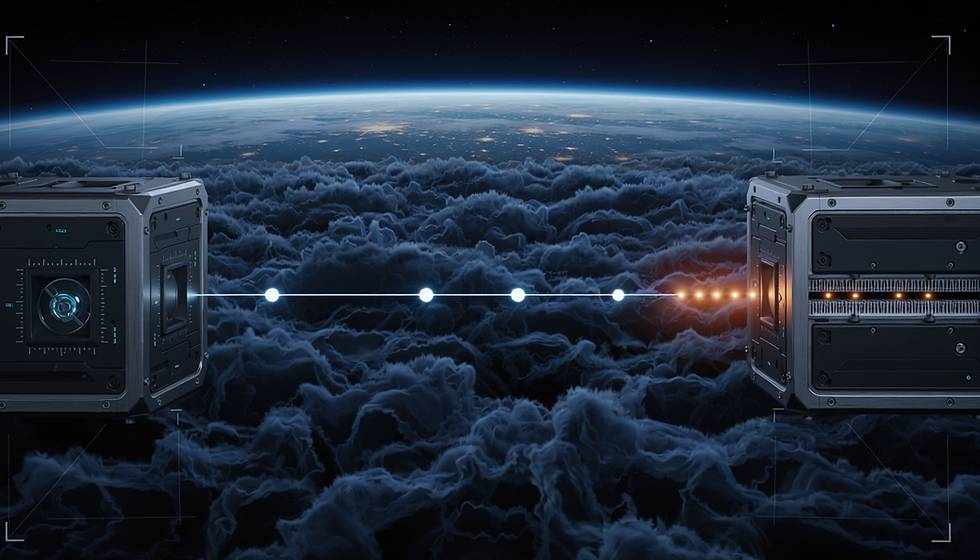
The quantum internet links distant quantum computers to harness their collective computing power. Achieving this will require major technology breakthroughs - and very accurate timing synchronization. This new quantum odyssey is now underway, but the voyage needs a little help from both Synchronos and Kairos.
Continued below in "The More You Know."
Last Newsletter Theme: Large Language Models, Tiny Time Budgets
🎓 The More You Know...
Like everything in the world of quantum, there are a lot of misperceptions about quantum networks.Strictly speaking, a quantum network/internet refers to the entangled network of distant quantum computers. Unlike classic networks or the internet, which simply move data, a quantum network actually uses the distribution of entangled photons to link these quantum computers. It is an amazing capability, but you can be forgiven if this is the first you heard about this - it requires some major technology breakthroughs and is a long way from practical realization.A sampling of these hurdles:
Transduction, or the ability for quantum computers to interface with photons, is arguably the toughest challenge. There are six different types of quantum computers, called modalities, all with different interfaces. The development of these interconnects is a focus of development.
Quantum memory and repeaters, are necessary to hold and pass along the quantum state of a photon, respectively. Normal fiber networks use amplifiers to overcome losses of optical communications. But amplifiers do not work with quantum communications. This requires entanglement swapping, a type of quantum teleportation (not to be confused with Star Trek-style teleportation), which in turn requires very accurate synchronization. Inevitably these will be difficult to install in undersea and long-distance fiber, which is why future quantum networks need satellites.
Distribution of entangled photons over fiber and space. The challenge here is adoption; a full-blown quantum internet is probably a decade away, so network providers are looking at other applications, like the delivery of time or encryption keys, as an interim step. Most of the work has focused on quantum key distribution (QKD) over fiber. But space is necessary because, as noted previously, photons don't last long in fiber and their quantum states cannot be amplified.
Quantum computers themselves. A lot of funding and focus is on the scale up of quantum computers to achieve quantum advantage, but the networking, or scale out, is getting less attention.
These challenges have led to the extension of the term "quantum network" to instead describe any application that distributes the quantum properties of single photons, weak coherent pulses (small groups of photons), and entangled photons. But to achieve the classic definition of the quantum network, timing really is everything.
To learn more, please email us.