

Digital Time Transfer
We live in analog world. All around us we are being bombarded by waves: sound waves hit our ears, light waves hit our eyes, RF waves hit our radios. And yet, long distance communications is primarily digital.
Why is that?
Because waves distort over long distances. You can easily communicate with somebody nearby, but if you try to shout across a canyon, it gets garbled.
So it's much better to deconstruct communications to discrete zeros and ones - bits - that can then be packaged, delivered, and reassembled at the far end.
And once you are in the digital domain, you can unlock new applications: we can use these bits to better extract a signal (akin to picking out a single voice in a crowded room), encrypt or mask a message, pack more data in available spectrum, integrate with computers, and store information.
Time transfer is also inherently analog. The simplest form of time transfer is visual - setting your watch to a reference clock, for example. But, like communications, synchronizing two clocks in the same room is easy; synchronizing clocks across long distances is hard.
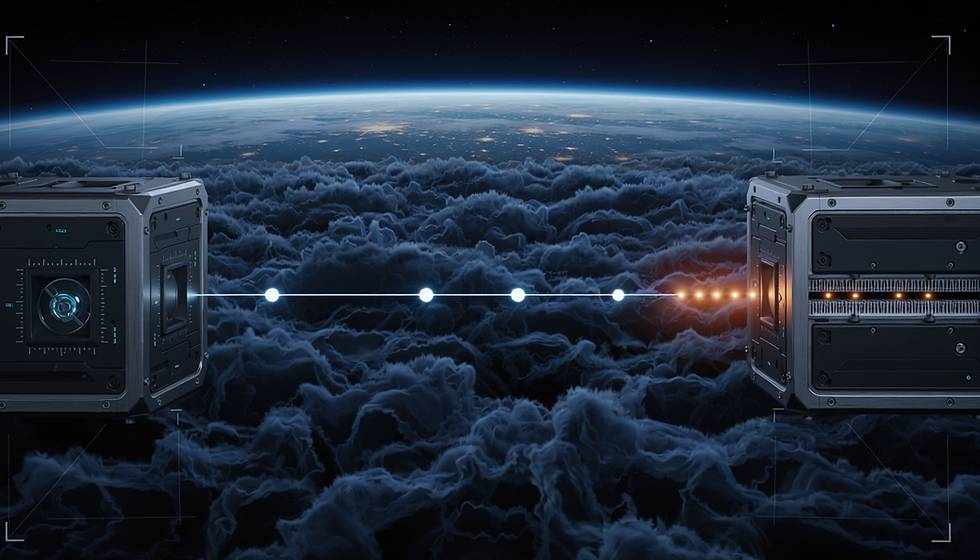
There is a new type of time transfer that works similar to the digital method, but instead of bits it relies on the smallest piece, or quanta, of light: the photon. We call it Quantum Time Transfer because it uses entangled photons for extra security. But it is also a form of digital time transfer, as it relies on the direct detection of the arrival of individual photons. Not only does this make it easier to overcome the long distance degradation of traditional analog time transfer methods, but also offers the opportunity to develop further timing resolution out of a noisy environment, while enabling new sensing, networking, and security applications.
Last Week's Theme: ...Looking Forward 2026


