Everything You Wanted to Know About Quantum Physics (But Were Afraid to Ask)
Quantum is all the rage nowadays, but it is hard to sort the science from the pop science.
At a basic level: quantum mechanics affects everything, but it really dominates in the world of small particles - atoms, electrons, photons, etc. It was only discovered a century ago when scientists accepted that matter and light consisted of discrete particles (quanta), and came up with clever lab and thought experiments to understand their behavior. And what they found was weird - at least compared to what we are used to.
For example, consider orbital dynamics: the moon orbits the Earth, the Earth orbits the sun, all on a deterministic and predictable path: if you know the current position and velocity, you know where it will be in an hour, a day, or any point in the future.
By the late 1800s, scientists knew that atoms were the smallest quanta of elements, and that they consist of electrons orbiting a nucleus made of protons. So when they pictured the hydrogen atom (one electron orbiting one proton), it seems like it should be in a nice orbit like a satellite orbiting Earth - but the math does not work.

So they laid out a crazy idea: what if the electron isn't orbiting the proton, but in a superposition across the whole orbit? Only when it is observed/measured, does it collapse from a superposition into a fixed position. And that position is not predictable - it is fundamentally random based on a probability that could be described with Schrödinger’s wave function equation. Even today, the mechanism of superposition and wave function collapse is controversial (see below in "The More You Know"), but experiment after experiment showed it works.
Einstein, though, had his doubts. So he devised a thought experiment that outlined the idea
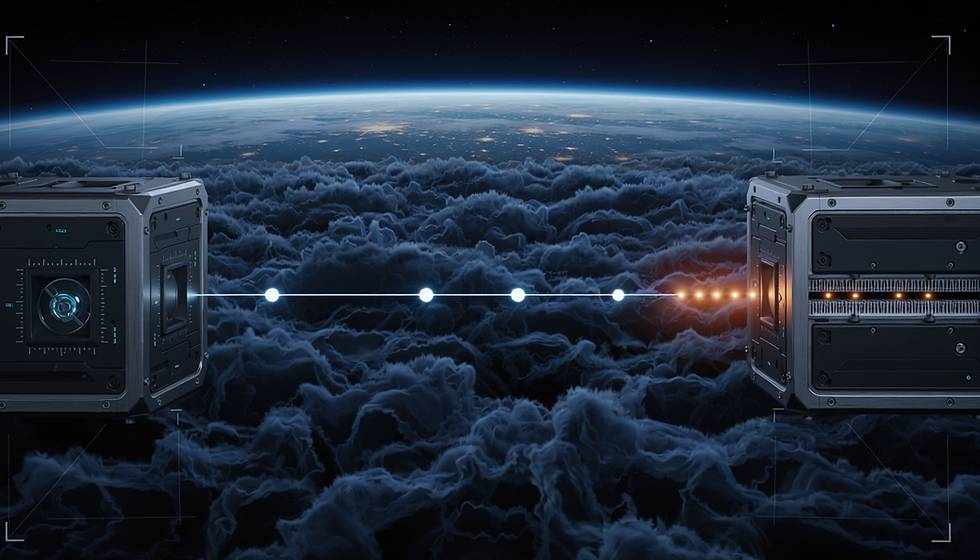
of entanglement to poke holes at this crazy theory. Imagine a particle in a superposition that splits in two. These two particles would then share the same superposition - they are entangled. And, if you separated these entangled particles, and measured one, it would collapse. But, logically, the other particle would need to collapse at the same time, no matter how far the particles are separated - a clear violation of the Theory of Relativity.
Instead, Einstein believed the entangled particles had a plan (a hidden variable) with the collapse delayed by the speed of light (locality). It would take another half-century before Einstein was proved wrong - entangled particles do share the same wave function, and, once one is measured, the collapse is instant and random.
Unfortunately, the vigorous debate on the nature of quantum mechanics was interrupted by World War II. Instead, this new field inspired the Manhattan Project, and quantum moved from theory into the lab. The resulting research led to further applications, like lasers, atomic clocks, LEDs, and semiconductors.
Today we can actually isolate and manipulate these small particles to start exploiting the magical properties of superposition and entanglement. Quantum computers and sensors trap ions, atoms, or photons for computing and sensing applications. Quantum communications leverage the quantum properties of photons for secure and accurate distribution of encryption keys, time, or sensing applications.
And all of this born from some crazy theories a century ago.
Last Newsletter Theme: The Odyssey
🎓 The More You Know...
Unsolved Quantum Mysteries
Richard Feynman, a Noble-prize winning physicist, famously said "nobody understands quantum mechanics." Read literally, that's not true - there are a lot of physicists that understand quantum mechanics. What he meant was: there are foundational aspects of quantum mechanics that have not been answered, and the theory of quantum mechanics is, at best, incomplete.
Consider these mysteries:
Can we ever hope to directly observe the quantum state, or are we reduced to just inferring results from experiments? The Measurement Problem (aka the problem of definite outcomes) states that "quantum systems have superpositions but quantum measurements only give one definite result." Experiments have proven that particles are in a superposition of multiple quantum states, until measured/observed, then it collapses.
What is really going on with wave function collapse? This is the prevailing theory, also known as the Copenhagen interpretation - but there are alternative theories. Maybe there is no collapse - maybe "all possible outcomes of quantum measurements are physically realized in different "worlds" (the Many-Worlds interpretation)? Or maybe the particle isn't in a superposition but in a definite position on a wave (the de Broglie–Bohm Pilot Wave interpretation)? Or maybe there is something else happening.
Where is the line between quantum and classical mechanics? We live in a world defined by classical physics - we would not be able to launch satellites if we could not predict its future location. But where is the dividing line? That was the main question posed by the famous Schrödinger's Cat thought experiment. There are some that think wave function collapse requires observation by a higher intelligence (which spawned some theories about consciousness, another unexplained natural phenomenon, being a quantum process). Though decoherence is now commonly accepted.
Does God play dice? Another central tenant of quantum mechanics is that wave function collapse is fundamentally random, which is well supported by experiments. Einstein believed that everything in the physical world is deterministic - that if you know enough information about a closed system, you can predict what happens next. But quantum mechanics suggests otherwise. And, if you believe that there is a quantum element to consciousness, then that means there is free will.
Is entanglement really "spooky action at a distance"? Einstein devised the original EPR Paradox thought experiment that outlined the idea of entanglement, primarily to show the ridiculousness of scientists embracing the Copenhagen interpretation. Einstein believed that entanglement had a hidden variable (i.e., was deterministic) and was subject to locality (i.e., occurred at the speed of light, not instantly). The argument raged until a brilliant mathematical proof devised by John Stewart Bell in 1964 was finally tested a few decades later. Bell believed his test would prove Einstein right, but the experiments showed they were both wrong - entangled particles both collapse instantly and to a correlated, but random, outcome. But testing continues.
Can a particle go through two doors at the same time? The results are in: yes, they can, but only if you aren't watching them.
Solve these quantum mysteries and the next Nobel prize is yours!
To learn more, please email us.